I was reading Megan Murray’s post about a recent Austin event on data centers, and it got me thinking about something that increasingly comes up when I talk about AI: the infrastructure behind it.
Some of the strongest pushback I hear about AI has little to do with the technology itself. People want to know about water consumption, electricity demand, emissions and the impact data centers can have on the communities where they are built.
Those are legitimate questions.
The rapid buildout of data centers to meet growing computing demand is putting more pressure on energy, water and local infrastructure. At the same time, figuring out the actual impact is harder than I expected.
I started digging into the data, particularly around water. No comprehensive national database lets you look up an individual data center to easily understand how much water it consumes, where that water comes from, whether it uses reclaimed or potable water, or what type of cooling system it uses.
Some companies disclose more than others. Some are investing heavily in technologies designed to reduce water and energy consumption. But the information is fragmented, and comparisons are difficult. Communities shouldn’t have to become data center experts to understand what a proposed facility could mean for where they live.
Infrastructure should be part of responsible AI
We talk a lot about responsible AI. We discuss bias, privacy, security, copyright, governance and how models are developed and used. For me, accountability for the infrastructure supporting AI belongs in that conversation too.
Not every AI company owns or operates a data center. An AI application may rely on a model from another company, which in turn relies on cloud infrastructure or other data center operators. That makes accountability more complicated, but it doesn’t make it irrelevant.
AI companies can be more transparent about the infrastructure providers they rely on and ask more of those providers when it comes to energy, water and environmental impact. Companies that own or operate data centers have an even greater responsibility to report their impact, explain what they are doing to reduce it, and engage with the communities where these facilities operate.
There will always be limits to what an individual AI company can know or control. Being transparent about those limits is part of accountability too.
Then I tried to calculate my own impact
Megan’s post also inspired me to try something. I use AI extensively. I wanted to understand what my own usage might mean in terms of energy and water.
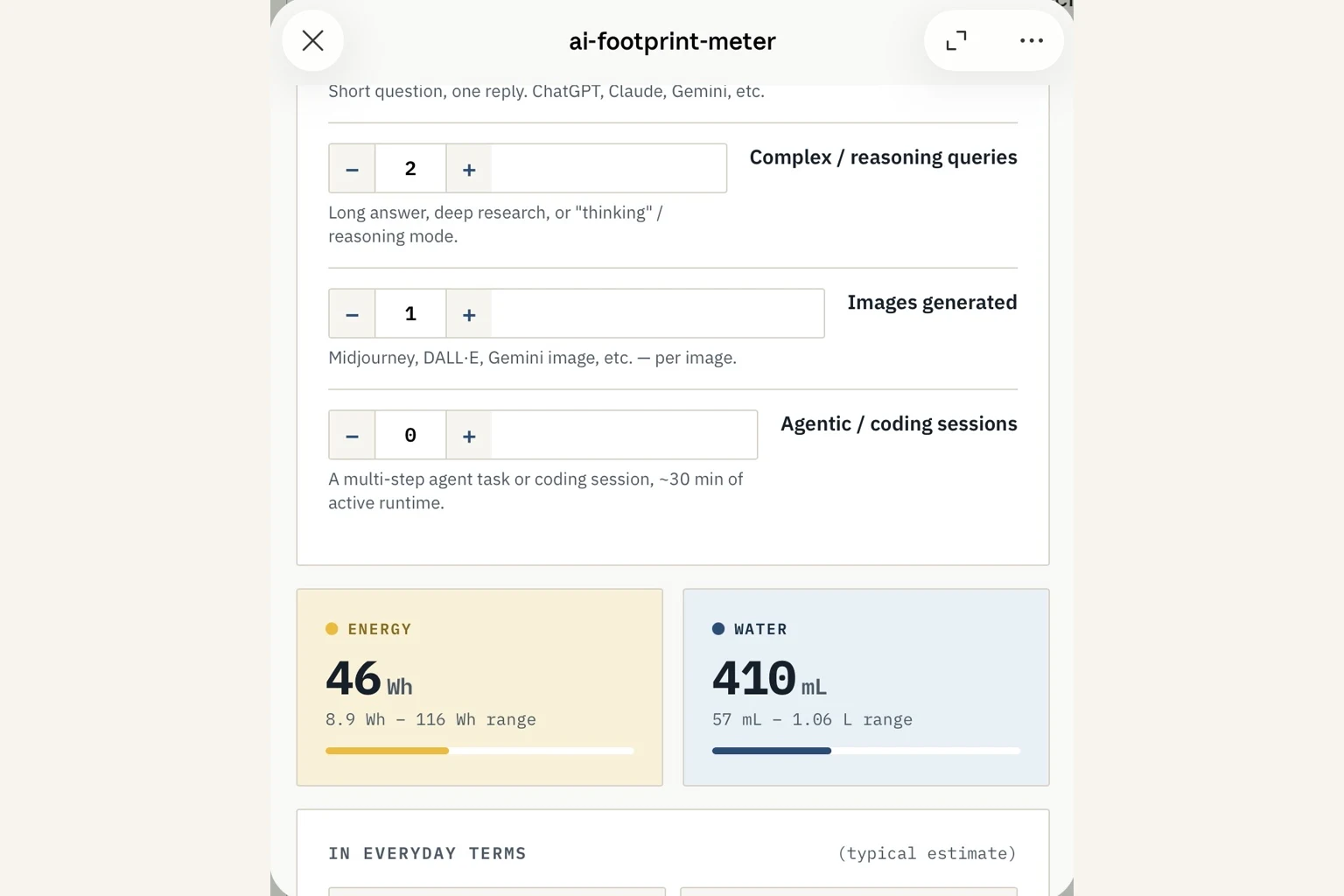
So I built a simple AI impact calculator.
You can enter your estimated number of quick chats, complex or reasoning queries, generated images and agent sessions per day, week or month.
The calculator then gives you modeled estimates of energy and water consumption, using low, typical and high ranges, along with everyday comparisons to make those numbers easier to understand.
But there is a pretty significant caveat:
I don’t know how accurate it is.
And after researching this, I’m not convinced anyone outside the companies operating these systems can calculate an individual’s AI footprint with much precision today.
Published estimates vary. Different models require different amounts of compute. A simple query and a long reasoning session are not equivalent. Hardware matters. The number of tokens matters. Data center efficiency matters. Location and cooling systems matter.
Even researchers studying AI energy consumption point out that estimates depend heavily on assumptions about models, hardware, workloads and what parts of the infrastructure are included in the calculation.
So the calculator gives you a range, not an environmental receipt.
Building the calculator had an impact too
There is another piece of this experiment that I think is important to disclose.
I used AI to build it.
I used ChatGPT extensively to research data centers, energy and water consumption and the different estimates available. Then I used Claude to help me build the actual calculator.
That meant multiple searches, reasoning sessions and a fair amount of back-and-forth while researching and building it.
In other words, trying to understand my AI footprint created an additional AI footprint.
Once the calculator was built, however, I deliberately made the tool itself simple. It runs using HTML, CSS and JavaScript in your browser. Changing the numbers in the calculator does not send a new prompt to an AI model. The calculations happen locally on your device.
I think that distinction is useful because not every digital interaction requires AI, even when AI helped create the product.
What I learned
I started this exercise wanting a number but what I found instead was an information gap.
We can estimate our AI use. We can make assumptions. We can look at research and disclosures from individual companies. But it remains surprisingly difficult for an ordinary user to connect an AI interaction to the infrastructure behind it and understand its actual environmental impact.
I don’t think the answer is to stop using AI. I certainly haven’t. But if responsible AI is going to mean something, we need to be able to ask questions beyond what happens inside the model.
Who provides the infrastructure? What resources does it use? What is being done to reduce its impact? What information is being shared with the communities affected by it?
And when the answer isn’t known, companies should be willing to say that too.
For now, my calculator is an experiment. Try your own numbers and treat the results as estimates, not facts. Maybe the most useful thing it calculates is how much we still don’t know.